
Table of Contents
Managing your Thrift Savings Plan account seems like a simple task – after all, there are only a handful of funds within the TSP. So it should be fairly easy to set up your account, allocate your investments, and make sure things stay in balance with the rest of your investment portfolio, right?

On the surface, this is true. But things can get more complicated when you add other investments to the mix. Let’s say, for example, you have a Traditional or Roth IRA. How would that affect your investment portfolio?
What if you have left the government or military service and now have a civilian 401k plan or another retirement plan? What about taxable investments such as mutual funds, stocks, bonds, or other investments?
Now things are getting a little more complicated. But they don’t have to be. Let’s take a look at how to manage your Thrift Savings Plan account – starting from making contributions, to making sure you have your funds in the right place, to ensuring your TSP fits with the rest of your investments. We will also look at types of accounts, risk management, and software you can use to make the job easier.
1. Review Your Contributions
The Thrift Savings Plan allows participants to contribute up to $22,500 per year, or up to $30,000 for those age 50 and over. It’s a good idea to review your contributions each year to make sure you are on track for your retirement. You don’t necessarily have to contribute the maximum each year to make a big difference in your retirement planning. Here are a few tips to get the most bang for your buck:
Are you contributing enough to get the match?
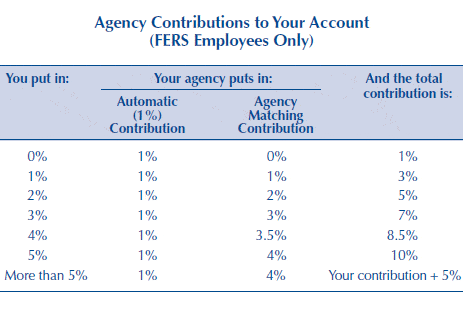
Civil servants and other non-military TSP participants get an automatic agency match on their contributions. Even if you don’t defer any of your compensation, you will earn 1% of your salary as an agency contribution.
You can get a 1% match for the next 3% of your salary that you contribute, and you will receive a 0.5% match for each of the next 2% of your salary that you contribute – up to a total of 5% match. That means you can receive a total contribution of 10% of your salary f you are willing to contribute 5% on your own. That is free money! See the chart below for more details on how the TSP agency match works:
Are you contributing special pay and bonuses?
Military members aren’t eligible for agency matching, but they are able to make additional contributions throughout the year if they receive special pay and bonuses. Military members can elect to contribute from 10 – 100% of their special pay and bonuses, including reenlistment bonuses, hazard duty pay, and career incentive pay. Even adding half of your special pay and bonuses will make a large difference in the long run.
2. Roth or Traditional TSP?
The Roth TSP is a new option for Thrift Savings Plan participants. The Roth TSP gives participants another option for retirement. Here is a quick overview of the options: The Roth TSP allows participants to make contributions with funds that have already been taxed, the contributions grow until retirement age, and then can be withdrawn tax-free during retirement.
The Traditional TSP works the opposite way: contributions are made on a tax-exempt basis and are taxed when withdrawn during retirement.
There is no one-size-fits-all approach to choosing between the Roth TSP and the regular TSP – each situation is unique. I recommend spending some time to look at your total investment portfolio, whether or not you already have a Traditional or Roth IRA, whether or not you will have a military retirement, and other factors before you make a decision.
3. Diversify Your Portfolio, Not Each Investment Account

Asset allocation is making sure your investment portfolio contains a balanced approach. That means an assortment of stocks, bonds, and other investments. The key to asset allocation is remembering that it applies to all your investments, not just individual accounts.
In other words, once you create the best asset allocation for your needs, you apply it across everything you own. This means you don’t need to create perfectly balanced asset allocation in your Thrift Savings Plan, another in your IRA, another in your 401k, etc.
All your investments work together. It may be better to put all of your TSP holdings into one or two funds if it makes it easier to balance your entire portfolio.
4. Be Careful with Target Date Funds
Target Date Funds are a one-size-fits-all investment plan. The fund is a balanced blend of stocks, bonds, and other investments that are automatically balanced for your retirement date. These funds are great – if you only have one investment account and all your investments are in that fund.
If you have more than one investment account, however, you need to be careful when using target date funds. My recommendation is to only use these funds if all your investments are in similar funds, otherwise, it can easily throw off your asset allocation.
5. Roll it in, or roll it out.
The TSP is a great place to invest – there are a variety of low-cost funds that cover most of the important segments of the market. But of you have left government service, you may no longer be able to contribute to your TSP. It may be a good idea to roll your TSP account into another retirement plan if you have a variety of other investment accounts, such as IRAs, 401ks, or other employer-sponsored retirement plans.
On the flip side, you might also be able to roll other retirement plans into your TSP. The idea here is to make your life easier by reducing the number of accounts you need to manage, which in turn, will reduce the amount of time and energy it takes to diversify and manage your investment portfolio.
6. Manage Risk
Is your asset allocation in line with your risk tolerance? To figure this out, you need to look at all the investments in your entire portfolio, including your TSP, and other investments. Decide upon your investing timeline (retirement date), goals, and how much risk you are willing to take. Then you need to make sure your investments are in line with your risk tolerance.
Target date funds are often already balanced in this manner, but it is difficult to maintain an entire portfolio if you have investments in several accounts. Often, the best way to make sure your investment portfolio has an appropriate amount of risk is to use software to help you analyze your entire portfolio.
An excellent, (and free!), software program is the Empower app, which can link to your TSP and other financial accounts to give you a full overview of your investment portfolio in one place.
7. Use Investment Tools to Help You Manage All Your Investments
Technology is amazing, and there are quite a few investment tools out there to help you manage your investment portfolio by understanding exactly what you have, what your risks are, and more.
One of my favorite tools is also a free tool – Empower. Here is an overview of how Empower works, and how you can use it to manage your TSP, along with all your other investments.
Empower Overview
Empower (formerly known as Personal Capital) is a free tool to help you manage your investments. It works like this: You open an account, link your investment accounts to it, and the tool analyzes your holdings based on the risk tolerance you give it.
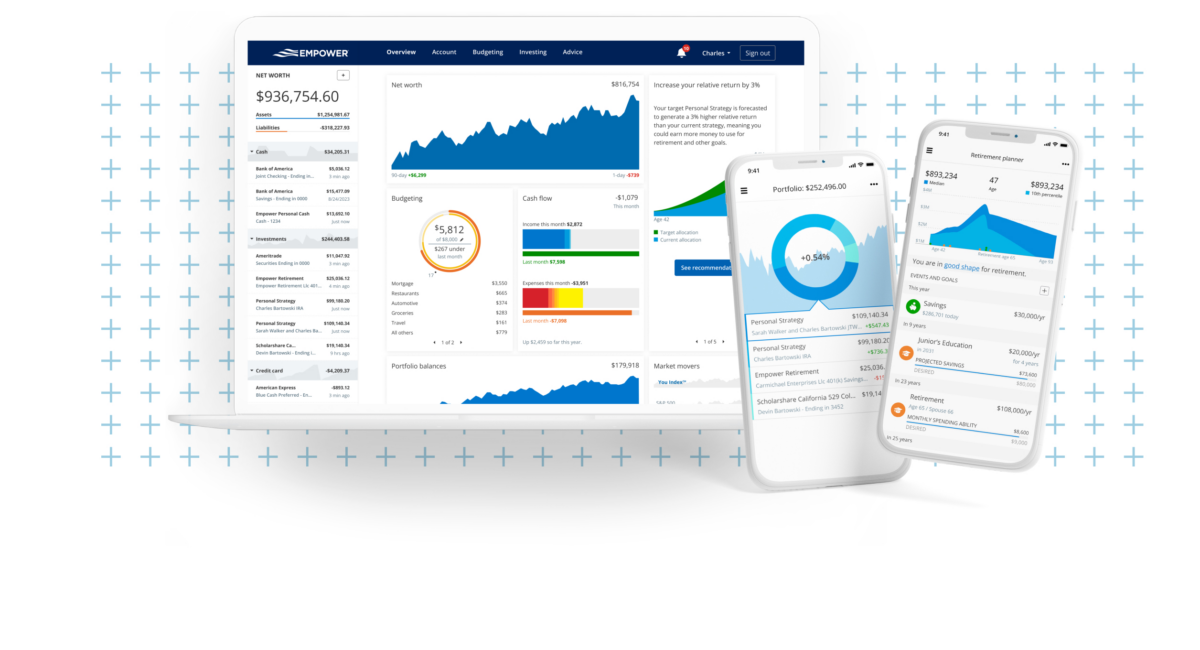
Based on your investments, this tool will help you balance your investment portfolio to ensure you are always at or near your desired asset allocation.
- How does it work? Empower analyzes your investments to make sure they meet your desired allocation. They can also help you visualize how much you are spending in management fees, and whether or not you can find similar investments elsewhere.
- Is it safe? Empower uses bank-level security, so yes, it is safe. I also use it personally and recommend it to family and friends.
- How do they make money if it is a free tool? You have the option of hiring one of their investment planners if you wish, or you can use this tool on your own. The investment planners have a fiduciary duty to you, which means they must make the best investment recommendation for your situation, not the investment recommendation that makes them a commission. You do not have to use one of their investment advisors, and you will not be bothered by them if you don’t wish to contact them.
- How can I open a free account? Visit the Empower website.
Overall, I think Empower is a great tool that can help you visualize how your TSP account integrates with the rest of your investments. This will help you maximize all your investments and manage them all in one location.
Get started today with the free Empower Personal Dashboard here.
Photo credits: TSP, s_falkow, Empower.
About Post Author









Comments:
About the comments on this site:
These responses are not provided or commissioned by the bank advertiser. Responses have not been reviewed, approved or otherwise endorsed by the bank advertiser. It is not the bank advertiser’s responsibility to ensure all posts and/or questions are answered.
Becky says
This information seems super helpful, but may have changed since TSP recently updated their website and these forms you discussed are no longer on their website…nor does the option to check the box to send tax-exempt funds to yourself seem to be available on the new website.
Mark Bierce says
I am retiring in December at age 62 and do not plan on withdrawaling any funds from my tsp until it is a mandatory requirement.
What is the best recommended account to move my funds into?
Thanks
CathiB says
With the addition of the new L Funds starting in 2020, is it wise to split contributions between two LFunds if your projected retirement date falls between the two? Also, I’m seeing more and more advice to allocate 100% to the LFund(s) with nothing towards G, F, C, S or I…thoughts? And finally, should I leave past contributions alone, or move the entire amount?
Ryan Guina says
Hi Cathi, These are great questions. I’ll answer them, but I also recommend reading more information about the TSP L Funds and how they work. This article answers all your questions in greater detail.
As far as which L Fund to use: There isn’t a huge difference between two adjacent L Funds – just choose the one that is closest to your retirement date or the one that you feel most comfortable with.
Regarding using more than one fund: The L Funds already have a little bit of the G, F, S, C, and I funds in them. So there is no need to add more to your account. In fact, it defeats the purpose. So yes, you should generally allocate all of the money in your account toward that single fund.
Regarding past contributions: You should move the entire amount, including previous contributions. The L Fund is a one-size-fits-all approach that is designed to be a “set it and forget it” fund. All you need to do is simply contribute the money to the fund and let it do its work over time.
I hope this answers your questions!